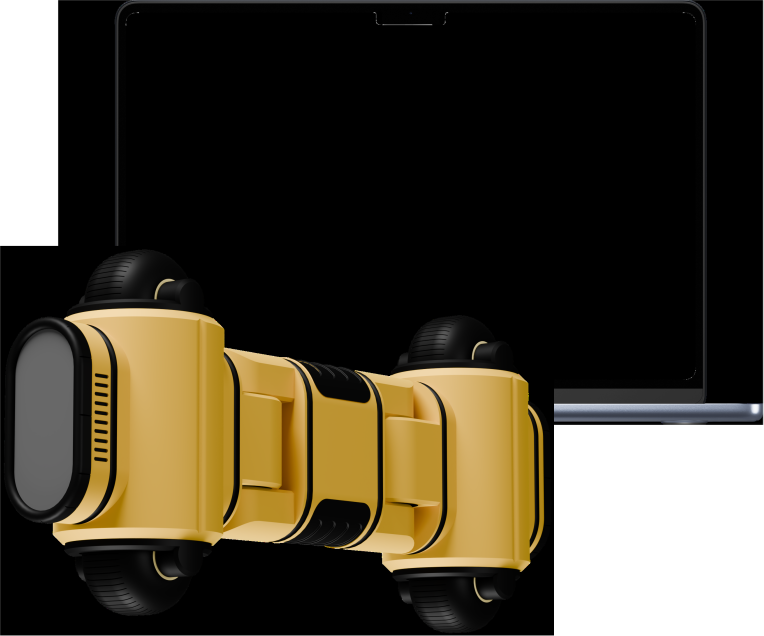
The Ferret is Puralink’s autonomous pipe inspection robot, designed to inspect pipe assets from 150mm and above in diameter. The system combines advanced robotics with a cloud-based data platform to capture, structure, and analyse inspection data.
During an inspection the Ferret collects HD CCTV, LiDAR, and positional mapping data, which is processed in PuralinkOS to generate structured inspection reports and asset maps.
Together, the Ferret and PuralinkOS form the Puralink platform for modern pipe inspection and infrastructure intelligence.
Traditional CCTV crawlers are effective for inspecting straight pipe sections but often struggle in networks that include bends, junctions, and/or gradients.
The Ferret was designed specifically for these environments. It combines advanced navigation, allowing it to move through corners, intersections, and manholes over distances of up to 1 km, with multi-sensor data capture that goes beyond standard CCTV to provide deeper insight into pipe condition.
The system also incorporates autonomous navigation, reducing the need for manual driving so operators can focus on condition assessment, and a modular architecture that simplifies servicing and allows new capabilities to be added over time.
The Ferret navigates complex pipe networks through a combination of advanced mobility and autonomous navigation software.
At the core of the system is Puralink’s patented drive architecture, paired with an active suspension system that allows the robot to expand and contract to maintain contact with the pipe walls.
This provides the traction and stability needed to traverse bends, corners, junctions, manholes, and vertical sections.Building on this mechanical capability, the robot uses onboard sensors and mapping systems to support autonomous navigation, allowing it to move through pipe networks with minimal operator input while maintaining orientation and avoiding obstacles.
The Ferret is designed to inspect a wide range of underground pipe assets. Initial deployments of the platform are focused on wastewater and sewer networks, where operators manage large and complex pipe systems.
The robot can operate in pipes 150 mm in diameter and above and is capable of navigating pipe networks that include corners, intersections, manholes, and vertical shafts.
In pipes between 150-300 mm, the Ferret can use its active suspension to expand against the pipe walls and climb vertically. In larger pipes, the robot operates in crawler mode, allowing it to inspect longer sections of network infrastructure.
While wastewater infrastructure is the first application, the Ferret platform is also applicable to other sectors with underground pipe assets, including utilities, energy, mining, and industrial infrastructure.
During an inspection the Ferret collects multiple forms of data to provide a detailed view of pipe condition and network structure.
This includes HD CCTV video, LiDAR-based depth data, and positional mapping data from onboard sensors. Together these systems generate millimetre-accurate spatial mapping, allowing operators to understand both the condition of the pipe and its precise geometry within the network.
By combining visual inspection footage with spatial mapping data, the Ferret captures more than traditional CCTV systems alone, enabling deeper insight into underground infrastructure.
All inspection data collected by the Ferret is stored and managed within PuralinkOS, Puralink’s cloud-based data platform.
Within the platform, inspection data can be easily searched, reviewed, and analysed, allowing operators to quickly access CCTV footage, mapping data, and other inspection information captured during a survey.
PuralinkOS generates inspection reports aligned with WSAA standards and allows inspection data to be exported into formats compatible with existing industry tools and asset management platforms. This ensures operators can integrate Ferret inspections into their existing workflows while gaining access to richer inspection data.
The Ferret is deployed in much the same way as a traditional crawler. The robot is inserted into the pipe through a manhole or access point, where it is lowered from the surface via its tether.
At the surface, the operator uses the Ferret base station, which includes a built-in tether reel and control interface for interacting with the robot during the inspection.
The robot operates on an onboard battery, while the tether provides a live data connection and serves as a redundancy mechanism for communication and retrieval if required.
Yes. While the Ferret is capable of navigating pipe networks with minimal operator input, an operator remains present during inspections to monitor the robot and assess pipe condition.
Unlike traditional crawlers that require constant manual driving, the Ferret handles much of the navigation within the pipe network. This allows the operator to focus on reviewing inspection footage, identifying defects, and making decisions when the robot encounters intersections or complex scenarios.
The result is a more efficient inspection process where the operator’s attention is focused on condition assessment rather than vehicle control.
The Ferret is designed to navigate many of the common obstructions found within pipe networks, such as debris, minor misalignments, and pipe defects.
Its active suspension system allows the robot to adjust its profile and maintain traction against the pipe walls, helping it traverse uneven surfaces and challenging sections of pipe.
In addition, the robot uses onboard sensors and navigation software to detect obstacles and adjust its movement accordingly. If the robot encounters a scenario it cannot safely traverse, it will stop and request input from the operator before proceeding.
The Ferret is designed to minimise the risk of becoming stuck in the first place. During an inspection the robot analyses the pipe environment and can identify defects or obstructions that may prevent safe traversal, allowing the operator to stop or change direction before proceeding.
If the robot does encounter a situation where it cannot move forward, its active suspension system can contract to its smallest profile (approximately 100-130 mm). This allows the robot to loosen itself from the obstruction and attempt to reverse out of the section.
If required, the robot can also be manually retrieved using the tether from the surface.
The first operators to receive a Ferret are participants in the Puralink Design Partner Program (learn more about the program here).
Our current cohort of design partners includes a mix of Tier 1 contractors servicing major utiltiies across Australia, dominant regional operators working with local councils, and small-to-medium contractors supporting private, industrial, and government infrastructure projects.
These partners are working closely with the Puralink team to trial the platform in real-world environments and provide operational feedback as the system progresses toward broader commercial deployment.
The first units of the Ferret have been allocated to participants in the Puralink Design Partner Program, which is currently fully subscribed.
Puralink expects to open commercial pre-orders in late Q2 2026, with the first commercial units delivered shortly thereafter.
Operators interested in securing early access can join the waitlist here to be notified when pre-orders open and future production batches become available.

51 Stanley Street, Darlinghurst, NSW, 2010
.svg)
.png)